La Mar 71
My grandparent’s house

My grandmother, “Mama” Maggie, is 96 year old and recently moved to a nursery home, closer to my mother’s house in Lima; and as part of that move her house for 70 years was put on the market and eventually sold. I didn’t really realized how important this house had been to me until I got the news that it was up for sell. I felt a sort of a “distant longing”: not quite sadness but more of an overall “uneasiness”, a slight rush of anxiety brought by the sudden realization that something from my distant past was no more. This is the house where an important number of the things that I now find interesting started taking shape: records, books, photographies. Normally, I am very aware of those moments in my childhood that shaped the person I am now, but the influence of this house caught me off guard.
The house “La Mar #71” is located in a Limean quinta, the “Quinta Carbone”, built at the beginning of the 20th century. A quinta for us Peruvians is a group of apartments that have a common street, garden, or chappelle. I doubt there are new “quintas” being built in modern Lima, which makes this setting a bit of an island in an ocean of high rises. Before it was the “Quinta Carbone”, it was an orchard where Chirimoyo trees were harvested. These are the trees of the “Chirimoya” (anana cherimola), a fruit practically unknown on this side of the continent: round, heart-shaped, with a velvety green exterior and white fibrous flesh inside with black seeds the size of small buttons. It has a pleasant earthy taste, half way between a pineapple and a banana and, now that I think about it, I don’t believe I have ever had it any other way than blended as a smoothie.
My abuelos’s home was not a fancy place by any means, but the living room had furniture that made you think that you were in the Peruvian version of a french room of the revolution era. The living room was the first thing you saw when you opened the front door, and it had a Louis XV couch & chair set with red velvet seats and on the walls hung mirrors with golden rococo frames. The fact that my grandfather built these pieces of furniture himself, made them even more special. I was a kid with a pretty active imagination and I would often fantasize how this lavishly decorated room could very well be what rich people had on every room in their houses.
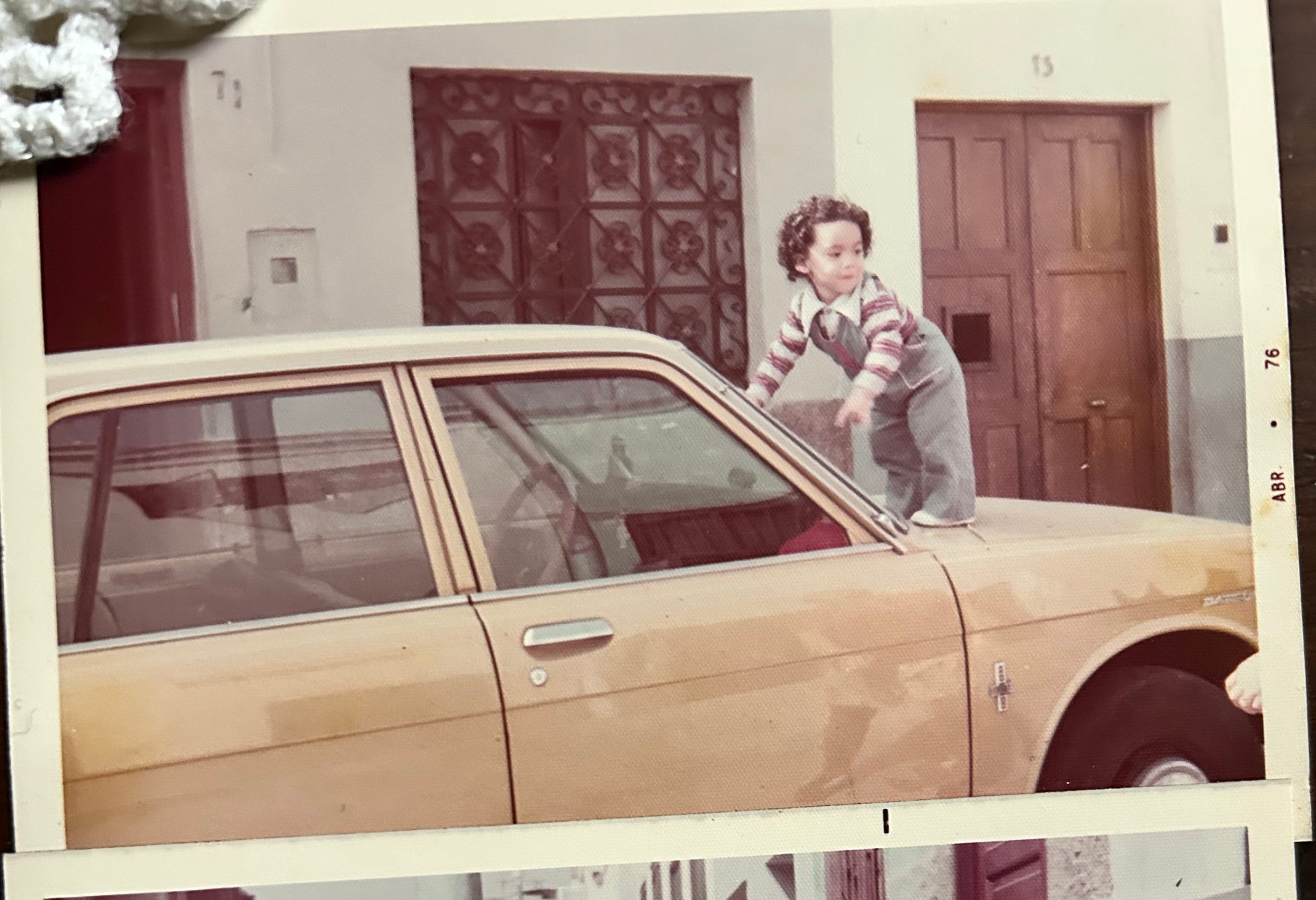
This living room was an important place in the house. It served not only as the place where the always-present visitors would spend time talking to my grandparents (this was a quinta after all, where nobody locked their doors and the neighbors came in to just say hi to briefly socialize, several times a day), but to me it also was the most magical part of the house, a time machine of sorts. I would spend hours browsing the old and outdated encyclopedias, playing vinyl records mostly from the 50s and 60s but, most importantly, it was where the photo albums lived. Page after page, these albums showed me a Lima that wasn’t there anymore, a place with tidy and clean streets, free of garbage and pollution and where the walls didn’t have graffitis and where people would wear their best attires to take a walk downtown on a Sunday afternoon in what was called “jironear” a wonderful word for the act of wandering on the streets or “jirones” of the city.
My grandfather worked at home, while grandma worked at the radio station. He had a workshop on the rooftop of the house which basically was a repurposed shed which I’m pretty sure he also built. Since it never rains in Lima, rooftops are flat with no shingles and people hang their clothes there out to dry, but also build extra rooms. I’m sure I spent as much time in that shed as I did in the living room of the house. To get to the rooftop you had to climb 2 flights of stairs. The first one from the kitchen up (which by the way had no ceiling, a feat only possible in Lima where it never rains and it’s never really cold either), but the second flight was the interesting one. You had to unlock a set of “cafe doors” that only covered the middle part of the door frame to have access to the stairwell which was pretty steep. If you looked to your right while climbing up, you could see the kitchen’s floor two stories down. Once you got to the roof, entering the shed was magical. It was like entering Gepetto’s workshop. The first thing you would see was a large wooden table against the wall that served as working bench. On that table near the edge, there was a bench vise & anvil convo, all made of metal. A strong, unbreakable, solid piece of metal which grandpa used with incredible dexterity, refined from years of using it.
Another room I have fond memories of, is the dining room. Gathering around the big table with my uncles, cousins, friends and grandparents on weekends and holidays it’s an anchor memory of my childhood. Grandpa Lucho was an excellent cook and gathering the family together and cook for them made him so very happy. He loved being in charge of the kitchen and demonstrate his prowess, crowned by the “skillet on fire” trick, where he would pour Pisco to his stir-frying lomo saltado (a staple of Peruvian cuisine) and make the skillet blazing; pretty impressive to watch. Having an open-air kitchen was definitely helpful here. Beyond lomo saltado, grandpa Lucho was also a master of peruvian-chinese food, called “chifa”. Legend has it that Lucho had, somehow, Chinese ancesters and that’s why he made these wonderful and colorful chifa plates: orange kalum wonton, yellow chinese fried rice, red fried wontons with tamarid sauce, brown chijaukay chicken, all delicious.
The house has now been sold and it’s the property of another Limean family. With it went the kitchen with no ceiling, the shed on the roof and the over the top rococo living room. Chances are, I will never go back to see it once last time, and I’m ok with it. Its rooms are gone, yes, but the stories, the memories, the smell of chifa and the photographs that transported me to another place, that all stayed with me
That was so lovely, Bruno. Thank you for sharing. I had chifa once in Norwalk, Connecticut. There was a Peruvian restaurant there. I also attended a Catholic school in Hong Kong in my childhood called St Rose of Lima. So I had always wondered what Lima was like.